
Wouldn’t it be wonderful if your colleagues were your best friends? Meaning, you like each other, you think in the same way and have a similar sense of humor, your values are matching, and you feel a click with the other person. Hence, no conflicts, no hard discussions, confrontations or escalations. It would be great for your motivation, for teamwork and so for the results of the company.
Unfortunately, the reality is different. We all sometimes need to collaborate with someone we don’t get along with because we have problems with their attitude, intelligence, habits, character or behavior.
I am afraid that it is pretty difficult to go to your manager, start complaining and ask for someone else to work with. Or even worse: start looking for another job (and get into the same problems with someone else). This isn’t something to be ashamed of; how could you possibly like everyone equally?
It is better to find out how we can work with a colleague that is not your best friend (yet).
Disliking somebody is one of the two reasons why people have problems with collaboration.
The other reason is that you and your colleague disagree. This disagreement could be about the way of working, priority setting, different vision or opinions, etc. But this is different from liking or disliking someone.
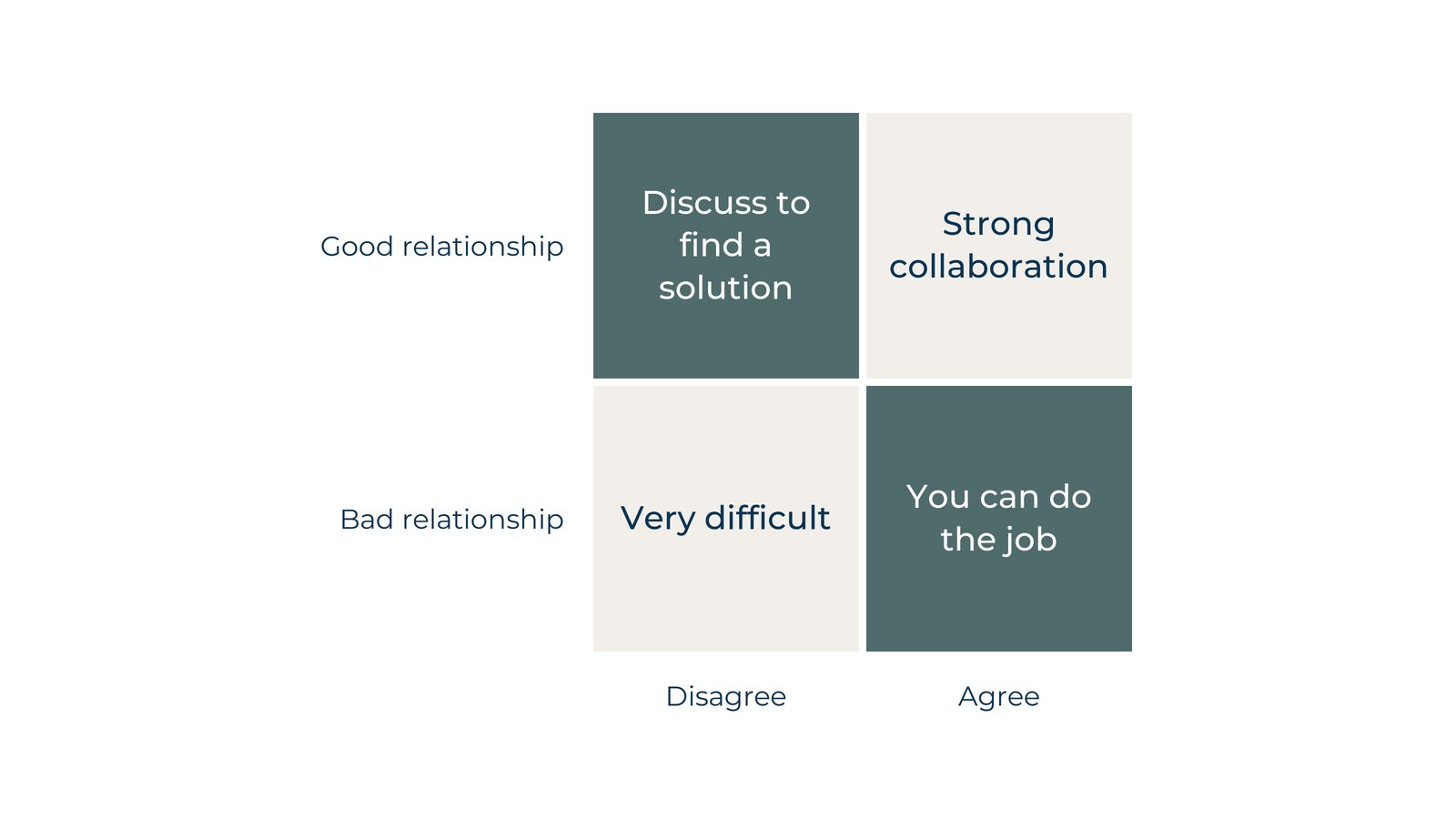
The chart above shows the four quadrants.
When you like your colleague and are in agreement, there will be a strong, fruitful collaboration. You are motivated and the results will be very good.
But when you like each other and disagree, you can easily discuss the different viewpoints. And most of the time you will find a solution, because you are “friends” with mutual respect.
In this blog I will share my thoughts on: don’t like.
What Are the Reasons That One Person Does Not Like the Other?
In general, we see the world through our own eyes, which is a feature of human cognition. And therefore other people may have irritating habits or strange behavior in the way we see it. A study by UCLA found that innate characteristics like gregariousness, intelligence or attractiveness are not so much the main reasons for disliking someone; it is more things like a lack of sincerity, transparency and empathy.
Elaborating on this, in business most people have problems with colleagues that come across as a poser, a griper or a drama queen, a person that is slacking off (cutting corners) or being passive, and on the opposite side the overachiever. Besides that, the arrogant or aggressive dictator, the person that knows it all, often a narcissist and so lacking any form of empathy, is rather hated. A different category are introverted people. They are silent, stick to the business only (no social engagement) and may come across as uncertain and indecisive. And then, there is the “yes” person. This could also be a form of uncertainty, as they always agree and never show their opinion, avoiding conflicts. What is the value of the word “yes”? Their counterpart is the “no” person, with one of their favorite sayings: “My answer is NO. What is your question?” And these make it difficult to collaborate.
What Can and Should You Do to Work Together in Better Harmony?
All of the reasons mentioned above should be discussed separately as they require different techniques to cope with them. But here I will share with you some things you can do in general.
-
If you don’t like a person, unconsciously you may be short with him or her, or interrupt without realizing it. They will notice your disrespect toward them and often respond with discourtesy as a confirmation of your negative thoughts about that person. Change that. Work on your awareness of your interpersonal style. We all, including the colleague you dislike, deserve respect and attention. You can’t change them, but you can change your reaction.
-
Show genuine interest in your colleague. What drives this person, what does s/he value in life, what are his/her opinions and ideas? What is his/her perspective? Listen carefully and ask incisive questions to understand the attitude, habits or behavior. There might be an indirect emotional reason for their behavior. And if you know that, there is a basis for change. See what you have in common and what you appreciate about the other. That will help to cope with the difference in character and you may come to the conclusion that you both have complementary skills and competences.
-
Although some advisors suggest avoiding the other person and limiting the contact time to the absolute minimum, I rather propose the opposite: meet frequently. Be kind and positive. If possible, go beyond the business and ask some light questions like: “How was your weekend?” “Did you watch that movie?” “Nice dress, where did you buy it?” Etc., etc. If you notice that your colleague wants to separate business from private life, then that is fine. There are enough business topics to talk about.
-
I have created very good cooperative relationships by inviting a colleague for lunch. Do it! Why? A quick lunch is a gentle way to discuss any topic in a more private setting while having some good food. You will get different information and a different view of the person (in both directions). Notice the difference in attitude after the lunch.
-
If you get irritated, reflect on the cause of tension. And this is how you respond to it: stay calm, take a deep breath and try to let it go. Besides that, ask in a gentle way if they can explain their attitude or behavior. Sometimes people do not realize how their behavior comes across. Most people do not have bad intentions. The answer to your question could be an eye-opener for both. But tell them that their attitude or behavior may have a negative impact on you and the cooperation. It shows that you are in control. You don’t want someone else limiting your success or happiness. You will be seen as a problem solver, rather than an opponent or critic.
THE GOLDEN NUGGET is self-awareness. Before looking at the other person, check if you recognize one of the above habits for disliking and if it applies to you. If so, why? Can you change it? Be critical.
There is much more to tell you about this important topic. So, please contact me if you would like to get more information or would like to be coached on working with people you dislike.
Knowing how to cope with this will make you both more successful and happier.
Joost