
Individualism accentuates the moral value of the individual. It includes autonomy, valuing free expression, self-responsibility and more distant relationships. According to Santos et al. (2017), individualism has increased by 12% over the past several decades.
However, in business we see that the need for collaboration and co-creation is also growing, because collaboration is key to organizational growth and innovation. In other words: teamwork. Having great teams and using their collective intelligence is crucial for success.
One of the questions I get a lot from my clients is: what should I do to create a truly great team?
The obvious answer to this question is that the key ingredients for a great team include good leadership, having senior, skilled people with the highest IQs, communication, having people who can work well together, focus on goals and results, fun, mutual support, structure and clarity, and diversity. All of this is true and important, but in 2015, Google did fundamental research to answer the question: what makes a team great?
Google came to the conclusion that the number 1 most important dynamic to make a team great is: Psychological Safety.
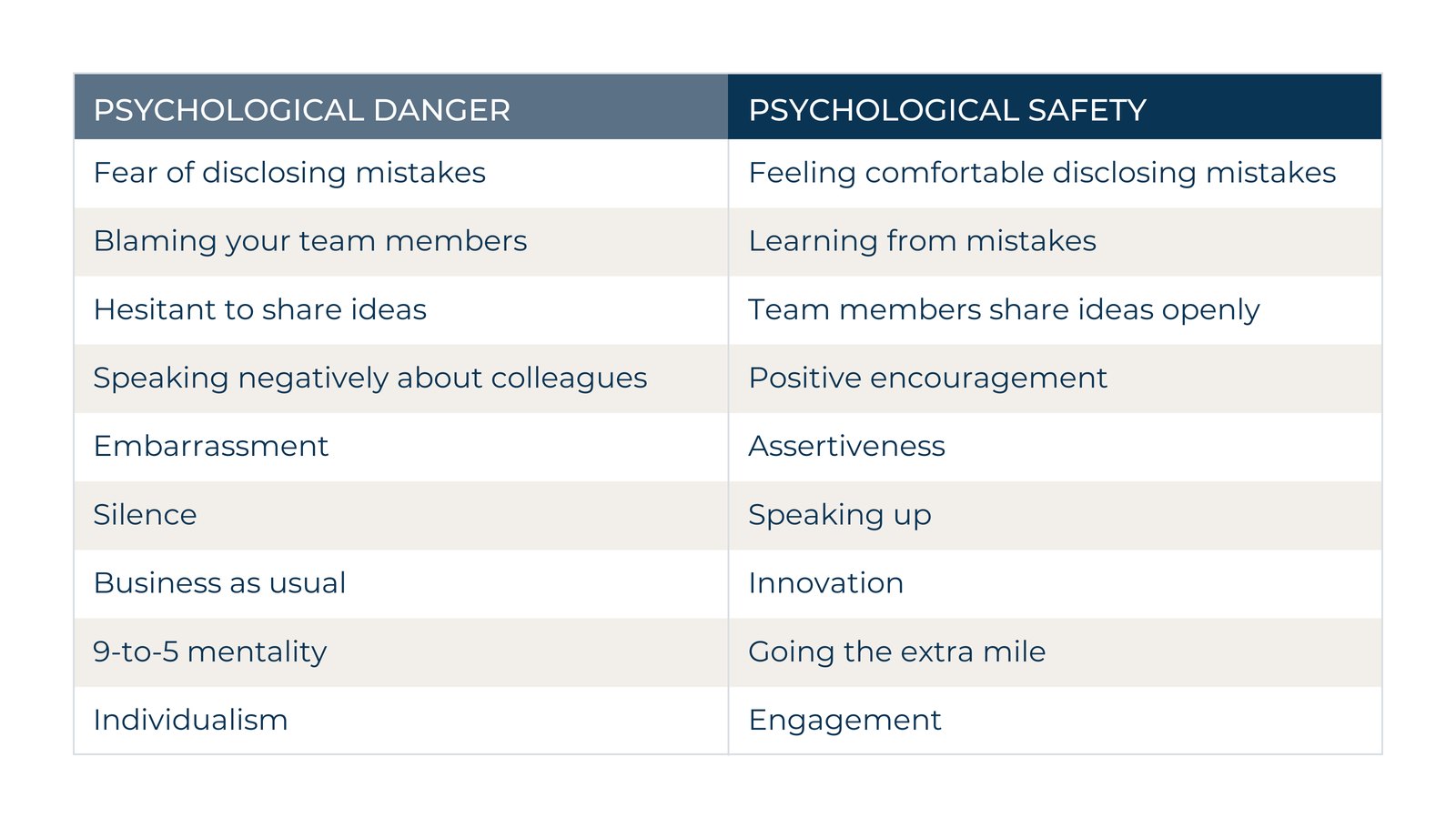
Professor Amy Edmondson (Harvard), who coined the term, says: “Psychological Safety is a belief that one will not be punished or humiliated for speaking up with ideas, questions, concerns or mistakes.” In other words, Psychological Safety allows you to show and employ yourself without fear of negative consequences to self-image, status or career. It is a shared belief that the team is safe for interpersonal risk taking.
Team members feel accepted and respected. Remember that each employee is a unique individual who wants to be recognized for their own skills. And that should be in a safe environment, because that is the foundation for exceptional performance, not just by the individuals, but by the entire team.
Psychological Safety is more than trust. Psychological Safety focuses on a belief about a group norm, and trust focuses on a belief that one person has about another. Psychological Safety is about how team members think they are viewed by other team members, while trust is defined by how one person views another.
If you are in Psychological Danger (being criticized, humiliated, etc.), your brain will react as if your life is threatened and it creates a threat response (the fight, flight or freeze response). We try to minimize the risk of being in a situation that is perceived as threatening by the brain. And that is exactly what we do not want; we want safety, because that will create success.
To check whether your organization is seen as Psychological Danger or Safety, ask yourself the following questions:
- Do people feel comfortable in team meetings asking about things they do not know or do not understand, or raising difficult issues?
- What is the reaction of your team members when someone makes a critical mistake?
- Do your team members give and receive honest feedback, including disagreements?
- Are team members appreciated for their skills, talents and commitment?
Psychological Safety takes into consideration the unique personality and skill set of the employee. This uniqueness of the individual should be seen as an asset rather than a burden. According to Tim Clark, the individual can feel Psychological Safety on 4 different levels: (1) being included, (2) learning, (3) contributing and (4) challenging.
How to improve Psychological Safety
Although in theory creating Psychological Safety is easy, in practice it has proven to be pretty difficult. Here are 10 important tips to start with:
- Show your team you’re engaged. Be present, pay attention and contribute.
- Understand and care. Find out if your colleagues feel safe and be empathetic.
- Treat your team members the way they want to be treated.
- Focus on solutions instead of blaming someone.
- Be a role model to show what you expect from the others.
- Don’t allow negative behavior and comments (about peers).
- Welcome out-of-the-box thinking, curiosity and innovation.
- Consult your team members in decision making and explain the rationale when the decision has been taken.
- Encourage feedback, questions and doubts, and have your team members challenge you.
- Ask the team members to use their energy for effectiveness.
There are many more best practices to optimize Psychological Safety.
I hope this will help you to become even more successful and happier than you are today.
Please contact me if you would like to get more information or would like to be coached on Psychological Safety.
Joost